
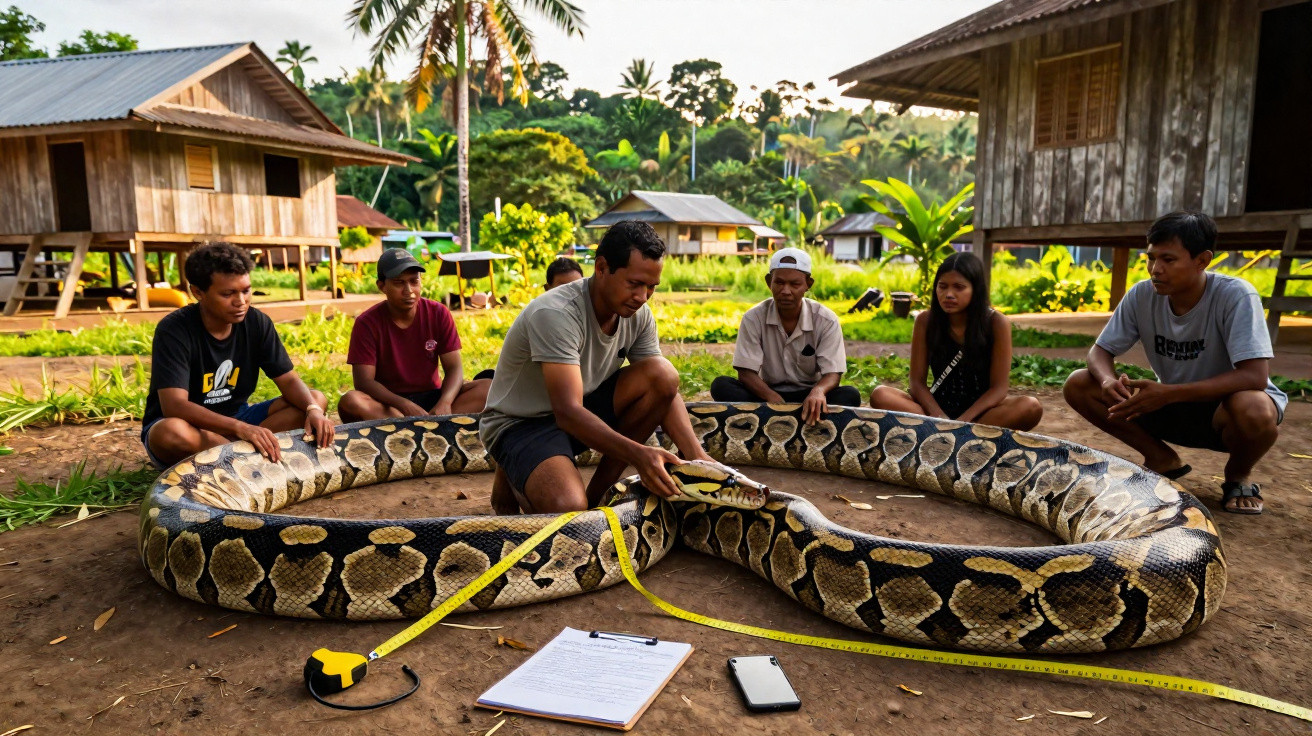
In tropical southern Sulawesi, an animal once confined largely to campfire tales emerged: a python as long as a football goal and as heavy as a fully grown person. What followed was a combination of luck, courage and meticulous scientific work.
How a rumour became a world-record snake
News travelled rapidly through the rural Maros area: an enormous snake was moving through fields and along forest edges, very close to where people lived. In Indonesia, stories like this often end fatally - for the animal. Large pythons are frequently beaten to death, sold, or vanish without trace before anyone has the chance to examine them properly.
Indonesian snake rescuer Budi Purwanto chose a different response. He understood that, if the animal was to have any chance at all, it needed to be secured - not for headlines, but for its basic survival. He moved the python to safety at his private snake rescue facility.
Photographer Radu Frentiu and wildlife guide Diaz Nugraha heard about the “giant snake of Maros” and travelled to Sulawesi. They knew that if they waited too long, the opportunity would disappear - either because the animal would be killed or because it would vanish into the jungle.
In the end, it was confirmed: this python is the longest wild snake ever verifiably measured.
“The Baroness”: numbers that are hard to believe
When the team arrived, they encountered a reticulated python named Ibu Baron - roughly translated as “the Baroness”. Guinness World Records subsequently recognised her as the longest wild snake ever measured officially and verifiably.
- Length: 7.22 metres (23 feet 8 inches)
- Weight: 96.5 kilograms
- Species: Reticulated python (Malayopython reticulatus)
- Location: Maros region, South Sulawesi, Indonesia
- Status: housed in a private snake rescue facility
The measurement took place on 18 January 2026. Using a precise measuring tape, the team followed Ibu Baron’s natural body line - without sedating her or pulling her straight. Every stage was recorded in photographs and videos.
Guinness notes that when a snake is sedated, its muscles relax and its body length can increase by ten per cent or more. In the Baroness’s case, this would probably put her at around 7.9 metres. For animal welfare reasons, the organisation rejects anaesthesia when it is used solely in pursuit of a record.
A snake that takes eight people to handle
The figures are striking, but anyone looking at the photographs immediately sees that this is about more than centimetres. To weigh her, helpers placed the snake in a large canvas sack and suspended it from scales normally used for rice sacks. Even that was a major physical effort.
For group photographs, around eight people were needed at any one time to hold the python safely. Her body does not resemble a long rope, but a series of engines linked together - every coil a separate powerhouse.
Frentiu estimates that the Baroness could easily swallow a calf, and perhaps even a small cow. This is more than a frightening thought: it illustrates her immense muscular strength and explains why people in rural areas fear animals such as these.
The python’s official record length would span almost the entire width of a regulation FIFA football goal.
Is she really the largest snake in the world?
From a scientific standpoint, the record is clear: no other wild snake discovery has currently been documented and measured with such care. Reticulated pythons are, in any case, regarded as the world’s longest snake species.
At the same time, the experts involved urge caution. Frentiu himself says that he does not believe for a moment that this is the largest wild snake of all; he simply had extraordinary luck. Nugraha considers specimens measuring nine metres or more possible, especially in remote parts of Indonesia.
The record is therefore worded very precisely: the longest wild snake reliably measured and documented to date - not the largest animal ever to have existed.
Why giant snakes are moving ever closer to people
The Baroness’s story is also one of shrinking habitat. Forests are being replaced by plantations, settlements and roads. At the same time, populations of wild animals are declining, including through poaching. Large predators such as reticulated pythons find fewer and fewer prey animals in the forest - and begin heading for goat pens and chicken farms.
This creates a dangerous combination for both sides:
- Snakes lose their natural habitat.
- People lose livestock to predators.
- Fear of attacks increases.
- In response, snakes are often killed or sold.
Reticulated pythons are non-venomous; they kill by constriction. This can be devastating for livestock and, in rare cases, for people too. Reports of fatal incidents make international headlines and intensify an already widespread fear.
There is also demand for snake meat and skins, as well as an illegal trade in exotic animals. A specimen such as Ibu Baron would represent ready cash for traders - and in most cases, nobody would ever know it had existed.
How one snake rescuer changed the story
In the Baroness’s case, events turned out differently. Budi Purwanto runs a kind of refuge for rescued pythons on his property. He took the animal in rather than passing her on. Without his decision, there would be no record - and the snake would probably no longer be alive.
Today, Ibu Baron lives in this protected enclosure alongside other rescued pythons. It is not a luxury hotel, but rather a compromise: better than the illegal market and safer than direct conflict with people. At the same time, her new home enables research, educational work and controlled visits.
Through Purwanto’s efforts, an alleged “monster snake” became an ambassador for species conservation and respectful treatment of wildlife.
How stories like this can help
Frentiu, Nugraha and Purwanto hope that the Guinness listing will encourage a change in perspective. When a community realises that “its” giant snake is making headlines around the world, perceptions often shift: from an object of fear to an extraordinary animal worthy of attention and protection.
Over the longer term, cases like these could also attract low-impact tourism - including guided visits to conservation centres, educational programmes for schoolchildren or partnerships with universities. Each of these activities can generate income without animals having to die.
What makes reticulated pythons so special
Reticulated pythons occur across South-East Asia and can be identified by their striking pattern of dark net-like markings on a lighter background. They are among the world’s longest snakes, although in the wild they usually reach lengths well below that of the Baroness.
| Feature | Typical reticulated python | Ibu Baron |
|---|---|---|
| Length | 3–5 metres | 7.22 metres (official) |
| Weight | 20–60 kilograms | 96.5 kilograms |
| Habitat | Forests, swamps, edges of villages | Forest and agricultural landscape near Maros |
| Prey | Birds, rodents, smaller mammals | Theoretically also calves and larger livestock |
It is precisely their size that makes reticulated pythons vulnerable to conflict. An animal capable of taking a goat or a calf is quickly seen as a threat, even though the snake generally avoids people. Many encounters therefore end in death - usually for the reptile.
What we can learn from the Baroness’s story
At first glance, record reports like this can seem like mere curiosities. Yet behind the figure on paper lies a whole cluster of issues: habitat loss, wildlife trafficking, fear of large predators, and the courage of individuals who choose to act differently.
For readers in Europe, a seven-metre python may seem far away. But the underlying question is familiar: how do we deal with wild animals that become inconvenient because they threaten fields, livestock or our comfort? The Baroness shows that there is room between “shoot it” and “let it go” - namely protection, managed care, research and education.
When people next read about “monster snakes”, they can put the term into context: reticulated pythons are remarkable, but not mythical creatures. They are responding to the same pressures faced by many other species - less habitat, less prey and more people. When one of them, like Ibu Baron, is seen not as a problem but as an individual worthy of protection, it represents a small but genuine step forward in our relationship with wildlife.






Comments
No comments yet. Be the first to comment!
Leave a Comment