
We have all experienced it: a supposedly fresh wash emerges carrying the faint smell of a wet dog. Sorting it out does not require cupboards full of specialist cleaners or hours spent scrubbing. All you need are two household staples and a few easy habits you can maintain.
One Tuesday morning, with the bathroom window slightly open beneath a porridge-coloured sky, I took a T-shirt from the drum and stopped. Beneath the detergent fragrance was that tell-tale musty note. The door seal appeared clean enough, but when I pushed my thumb into its fold, a slick droplet travelled along the ridge. The answer is more straightforward than it seems.
Why your washing machine smells in the first place
Your washing machine is not dirty in the same sense as a bin. Rather, soap scum, fabric softener, lint and hard-water minerals gradually collect and form a stubborn coating. This layer feeds microbes, which create odours when the door remains closed and the drum stays slightly damp.
A neighbour in Bristol said her drum began to smell after a winter of speedy 30°C washes and generous doses of softener. She assumed the fragrance would mask the issue, but it had the reverse effect: floral perfume combined with a suggestion of pond water. Most washing machine smells start this way, as a gradual build-up rather than one error.
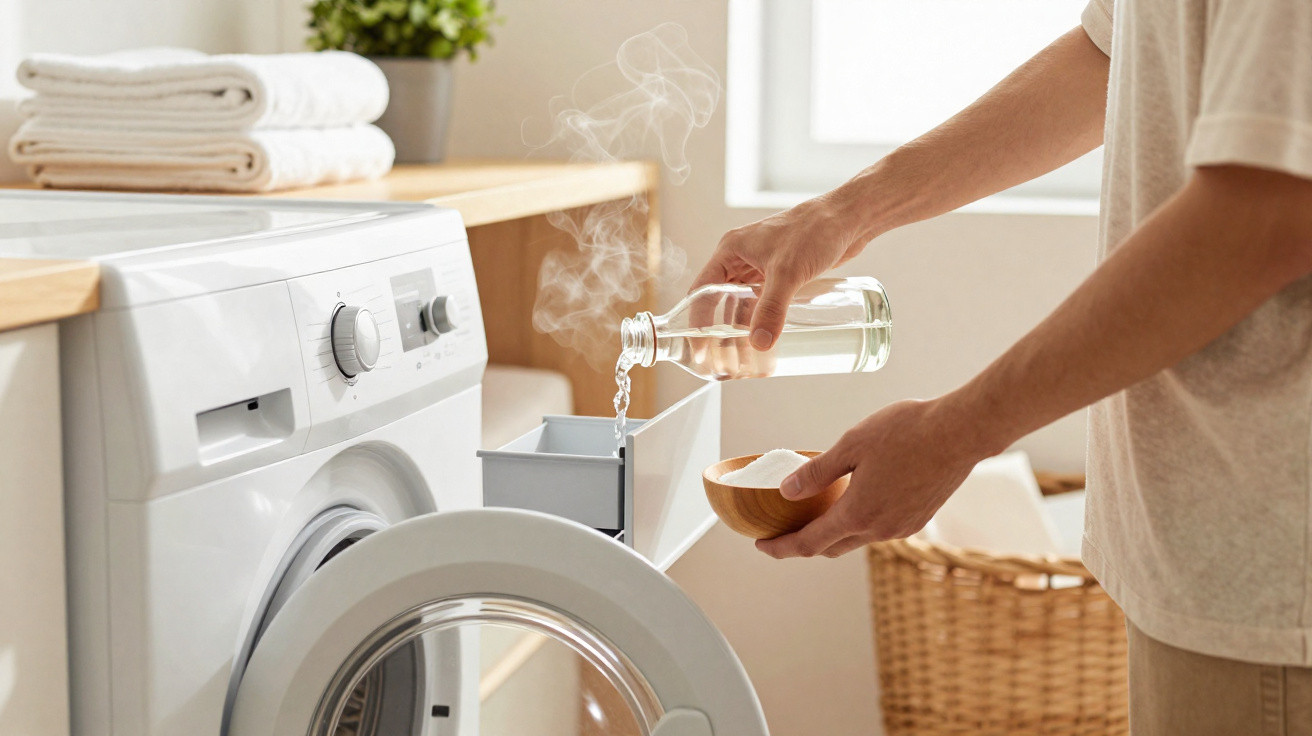
In simple chemical terms, white vinegar breaks down mineral scale and soap residue, loosening the persistent film so it can wash away. Bicarbonate of soda absorbs odours and shifts the pH closer to neutral, helping to release what the vinegar has softened. Send hot water through the machine and the biofilm can no longer hold on. Bicarbonate of soda and white vinegar are the only two things you need.
The two-ingredient washing machine clean: a simple routine
Begin with the machine empty. Tip 250–400 ml of white vinegar directly into the drum and select the hottest maintenance programme available, preferably 60–90°C. Where your machine has a pause function, halt the cycle halfway through for 20–30 minutes so the vinegar can sit on the internal surfaces, then allow the programme to finish.
Afterwards, scatter 2–3 tablespoons of bicarbonate of soda into the drum and run a brief hot rinse. Once it is complete, leave the door open and use a clean cloth to wipe the rubber seal, door glass and inside of the drum. Never mix vinegar with bleach - ever. If bleach has been used recently, wait a day and run a couple of rinses before using this method.
A few minor changes will prevent the odour from returning. Use less detergent, avoid fabric softener for towels and leave both the door and detergent drawer open to allow air to circulate. Realistically, no one manages this every day. Leave the door and detergent drawer ajar after every wash.
“If your machine smells, it’s not the clothes - it’s the biofilm. Break the film and the smell goes with it,” a repair engineer told me on a call-out in Leeds.
- Monthly: one hot vinegar cycle, one short bicarb rinse.
- After washing: wipe the inner lip of the door seal, where water collects.
- Use powder for heavily soiled loads; gels may cling more.
- Once a season: remove the drain filter and clear away fluff.
- Run at least one 60°C wash each week if you regularly use cold cycles.
What to expect - and how to keep it easy
Following the first vinegar cycle, the smell commonly changes from “swampy” to “barely there”. The bicarb rinse generally completes the task, leaving the drum neutral rather than artificially perfumed. Where a machine has accumulated residue for years, repeat the routine the following week and inspect the filter for trapped coins, hair ties or mats of lint that hold sour water.
It helps to think about the task differently. You are not giving a faulty appliance an intensive clean; you are simply allowing a water-using machine to dry between baths. Leave the door slightly open, pull the drawer out by a centimetre and give the seal a two-second wipe as you remove the final sock. They are small routines, not chores with a capital C.
In hard-water homes, vinegar is a discreet helper because it softens scale whenever it circulates through the machine. The routine matters even more for large families, as more loads create more residue. Once it becomes a monthly habit, it takes less time than making a cup of tea and waiting for the kettle to cool.
The science made friendly: vinegar and bicarb, no drama
Consider vinegar the dissolver and bicarbonate the deodoriser. Vinegar is mildly acidic, which means it breaks down the chalky deposits that soap readily clings to. Bicarb is mildly alkaline, so it tackles lingering odours and helps rinse away loosened grime. Adding both at once produces an entertaining fizz, but they mostly turn into salty water, which does little for a machine’s hidden areas. Applying them one after the other uses both benefits without the spectacle.
More than a clean drum: tiny rituals that change the whole room
Fresh laundry is about more than a pleasant scent. It means your gym kit will not return with a hint of swamp, the baby’s sleepsuits will not develop a stale smell overnight, and visitors will not question why the hallway has an odd hum on wet days. Share the method with housemates or show the teenager who has only just discovered fabric softener. This two-ingredient approach endures because it is inexpensive, fast and forgiving - and it works even on a Tuesday when the sky is the colour of porridge. Give it a go this week and see how the washing machine smells after three days. Then share your favourite small hack with someone.
| Key point | Detail | Benefit for the reader |
|---|---|---|
| Two ingredients | White vinegar (250–400 ml) and bicarbonate of soda (2–3 tbsp) | Low cost, already in your cupboard |
| Order matters | Run a hot vinegar cycle, then a short bicarb rinse | Stops neutralising fizz, gets a deeper clean |
| Keep it fresh | Door and drawer ajar, quick wipe of the seal, monthly repeat | Prevents the smell returning with minimal effort |
FAQ:
- Which two household ingredients are we talking about? Plain white vinegar and bicarbonate of soda. No scented vinegars, no baking powder, just the basic stuff.
- Will vinegar damage the rubber seal or hoses? Used occasionally and diluted by a full hot cycle, white vinegar is gentle on modern seals. Don’t soak rubber parts in neat vinegar for hours on end.
- Can I pour vinegar and bicarb in together to save time? You’ll get a satisfying fizz, then a mostly neutral solution that cleans less effectively. Split them into two steps for proper results.
- How often should I do this routine? Monthly suits most homes, fortnightly if you wash constantly or live in a hard-water area. A quick wipe of the seal after each wash makes it last longer.
- What if the smell comes back quickly? Check the drain filter for trapped fluff, coins or hair ties. Run one 60°C load a week, reduce softener, and let the machine dry with the door and drawer open.



Comments
No comments yet. Be the first to comment!
Leave a Comment