
The lid will not budge. Your fingers are already slightly red, and small misty semicircles have formed on the jar because you are gripping it so tightly. WhatsApp messages ping in the background, water boils over, and someone calls from the living room: “Everything all right?” You press your lips together, twist a little further and feel a tiny pain in your wrist. Nothing. Still nothing.
We have all been there: the jar wins. It is an ordinary object, yet it feels like a miniature defeat. You call for “strong hands”, wrap a tea towel around the edge or desperately search online for home remedies at the same time. Then, somewhere between the sink and the hob, a piece of cutlery appears and suddenly seems like a tiny superhero: an everyday spoon with a remarkably clever trick.
Why stubborn lids are so irritating – and what is really causing it
This is about more than jam or tomato sauce. A lid that refuses to move can feel like a quiet comment on everyday life: you are stressed, rushed, hungry – and a jar brings the entire routine to a halt. That tiny interruption to your flow is surprisingly infuriating because it seems so pointless.
Supermarkets promise everything will be “quick, practical, easy”. Then, in the kitchen, you find yourself fighting over a few millimetres. A lid that will not open ruthlessly reminds us how little we truly control in daily life. That may sound exaggerated, but those few seconds often concentrate all the frustration of the day. No wonder we swear, laugh or fling the jar into a corner in annoyance.
I recently spoke on the phone to a friend in the middle of one of these minor crises. “Hang on,” she said, “I’m currently losing to a jar of olives.” In the background, I could hear the tugging and huffing, followed by a dull clunk. Later, she sent me a photo: shards of glass in the sink. “Tried force,” she wrote, “now the olives are ruined.” It is a small but very typical scene – and not an entirely harmless one.
Many people try to free a lid using hot water, rubber gloves or sheer strength. Some tap the rim with a knife handle, while others push knife tips beneath the lid. Household forums contain accounts of cuts, shattered jars and scalded fingers. These are the methods people have “always used” – until something goes wrong. The frustration is understandable, but the danger is often underestimated.
The straightforward truth is that, in most cases, your own strength is not the issue: it is the vacuum inside the jar. As a filled jar cools, the pressure inside becomes lower than the pressure outside. The lid is effectively sucked into place, and the familiar “pop” when it is first opened is the pressure suddenly equalising. Simply twisting harder means battling physics. Change the pressure, and you can win with very little effort.
The spoon trick: release the vacuum with one simple movement
The trick sounds almost too easy: all you need is a standard teaspoon. There is no need for specialist equipment or a gadget from a television advert. The only important point is that the spoon should be sturdy and have a slightly rounded edge. Thin, flexible cheap spoons are less suitable, as they are more likely to bend than do the job.
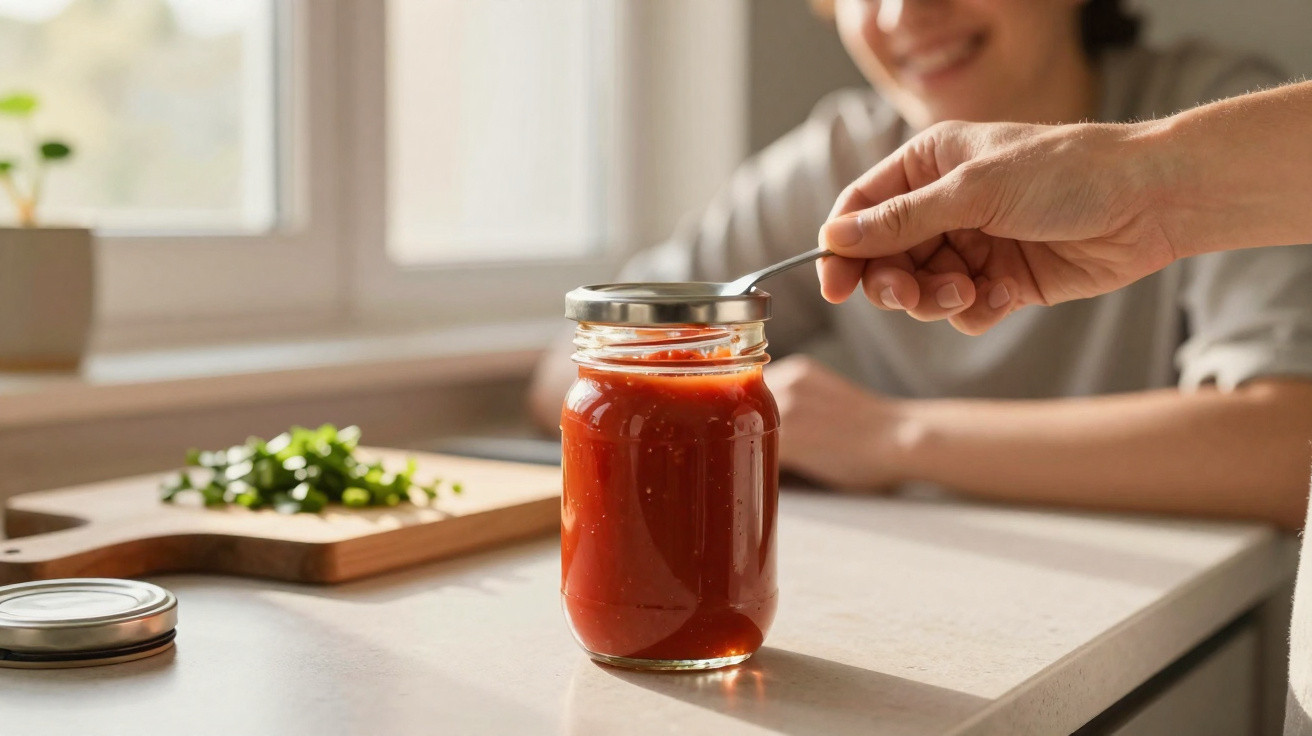
Hold the jar in one hand securely but without tensing up. With the other hand, carefully place the edge of the spoon beneath the rim of the lid, where the metal edge protrudes slightly beyond the glass. Approach it from the side, almost horizontally, rather than from above. Next, lift it ever so gently – just a fraction. There is no need for a dramatic crack. Often, a quiet “hiss” as air enters is enough. The lid will then turn as though it had never been stuck.
At this stage, many people make the same common mistake: they lose patience. They lever too hard, too quickly, or in a place where the glass and lid sit too close together. That can leave dents in the lid or, in the worst case, break the jar. When you are already angry, your hand is also more likely to slip. Anyone who has watched a shard fly in the wrong direction remembers it for a long time.
Gentle is the key word here. A tiny amount of pressure is generally sufficient to break the vacuum. You do not need to lever all the way around or look for half a dozen points. One carefully positioned attempt will often do the job. And yes, it also works for plenty of jars that have been sitting in the cupboard for a long time. Let’s be honest: nobody regularly retightens every lid simply to make it easier to open later.
A friend of mine who works as a nutritionist describes the moment like this:
“When my clients consciously try the spoon trick for the first time, you can practically see a switch flip. Suddenly, that annoying jar is no longer a barrier, just one small movement.”
To make that lightbulb moment happen reliably, this short checklist can help:
- Choose a sturdy spoon rather than a thin metal model.
- Slip it beneath the lid edge carefully; do not jab it in with force.
- Lever only lightly, until you hear the faintest hiss or click.
- Keep your hand and the jar dry to prevent slipping.
- Once opened, briefly check whether the lid still seals tightly.
What changes when a jar lid is no longer an opponent
Solve one small everyday problem and the kitchen suddenly feels a little easier. It may sound dramatic, but it is remarkably noticeable. When you no longer have to wonder whether you “really want to open” a particular jar now, you are more likely to reach for things that would otherwise remain unused. Pickled beetroot, chickpeas and forgotten olives all come back into view.
The spoon trick quietly acts as an invitation to make proper use of your cupboard shelf. No more calling into the living room, “Can you just…?”, and no more jar-against-the-table-edge moments. Instead, there is an unremarkable, almost elegant movement. Once people have taken it on board, they automatically show it to others – while cooking in a shared flat, visiting family or staying at a friend’s holiday home.
Then a lovely, quiet snowball effect begins. It is a tiny piece of knowledge that needs no app, password or tutorial. Just a spoon and a little respect for physics. Perhaps these unobtrusive little tricks are exactly what makes everyday life feel more human. They show that many apparently “strong” obstacles disappear when we apply a light touch in the right place.
| Key point | Detail | Benefit for the reader |
|---|---|---|
| Spoon rather than brute force | Place a teaspoon beneath the lid edge and lever gently | A gentler, safer way to open stuck lids |
| Understand the vacuum | The tight seal is caused by a pressure difference, not “superhuman strength” | Less frustration and more control in everyday kitchen life |
| A gentle routine | A short checklist for grip, positioning and pressure | Helps prevent injuries and saves time and stress |
FAQ:
- Does the spoon trick work on every jar? It works with most screw-top jars that have metal or rigid plastic lids. Very thin glass or badly misshapen lids may make it more difficult.
- Could this make the lid leak? A gentle leverage point usually causes only a minimal dent, which barely affects resealing afterwards. However, levering very hard can cause the lid to lose its seal.
- Is the trick safer than hitting the jar on the table edge? Yes, because the jar is not subjected to an impact. The risk of cracks and splintering glass is greatly reduced as long as you work carefully and without force.
- Does it help to hold the jar under warm water first? Heat can expand the lid slightly and make it easier to open. Combined with the spoon trick, it often works particularly well – especially with very old jars.
- What should I do if the spoon trick does not help? Wrap a rubber band around the lid for better grip, then repeat the spoon approach at a second point. If nothing moves, do not force the jar; dispose of it to avoid injury.






Comments
No comments yet. Be the first to comment!
Leave a Comment