

There is something timeless about sketching stick figures, weapons and monsters in the margins of your homework.
Even in the era of iPads and Minecraft, most children given a pencil and paper – especially alongside an assignment they would rather put off – will eventually join the ancient tradition of doodling.
Onfim’s 13th-century homework doodles
A child called Onfim shows us just how long this habit has existed.
Long before the 'cool S', Onfim made his remarkable mark on soft birch bark in the middle of the 13th century.
Historians think he was about 6 or 7 years old when he produced these extraordinary doodles. In many respects, they reveal more about a child’s life in medieval Russia than the schoolwork surrounding them.
As he practised writing in Cyrillic, he drew himself and, presumably, his friends standing in a row beneath the letters:
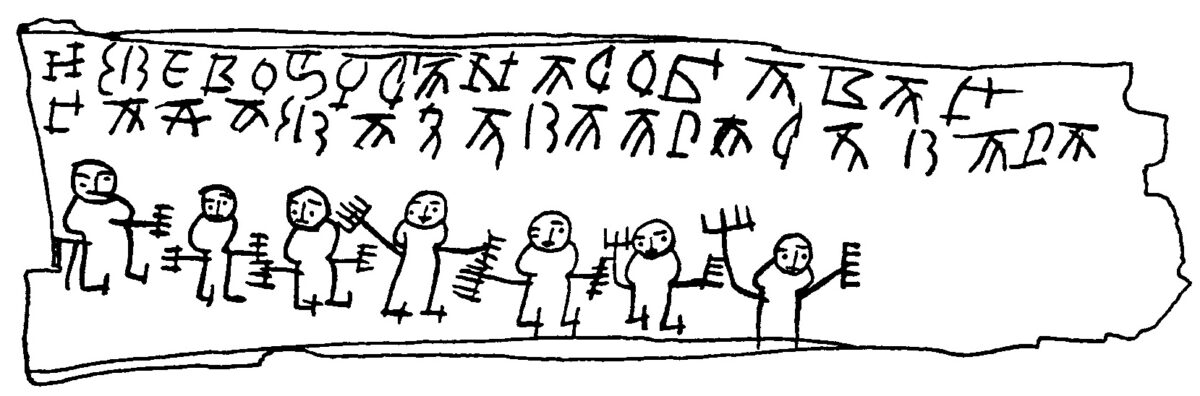
Cyrillic letters above seven human stick figures. (Onfim of Novgorod, copy by gramoty.ru/Wikimedia Commons/CC BY-SA 3.0)
On the reverse of his homework, he pictured himself as a “wild beast”: a centaur-like figure with a curled tail.
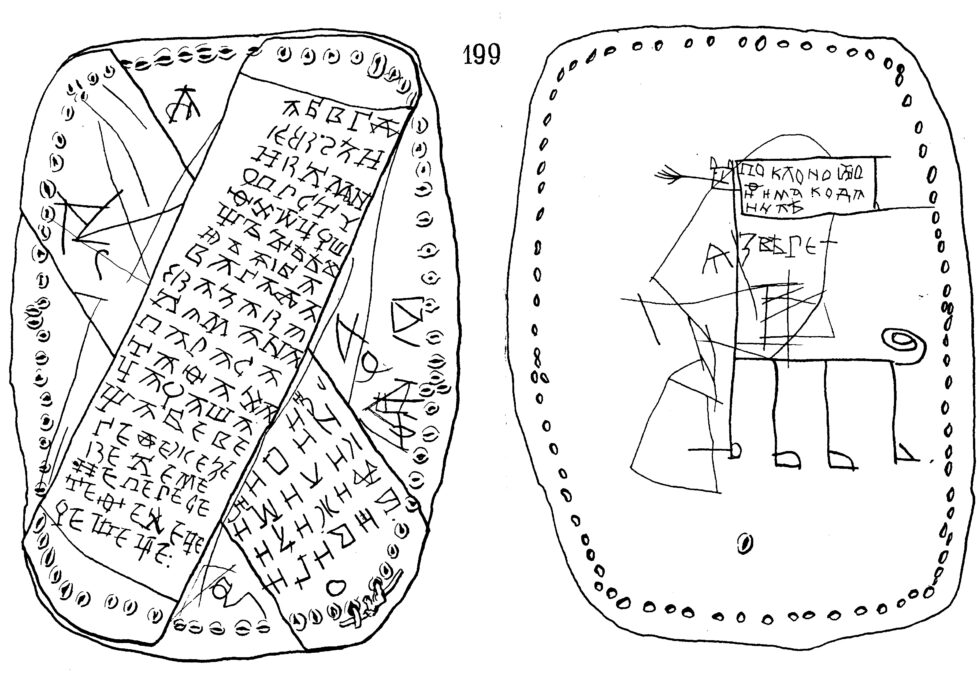
Sketches depicting Onfim’s birch-bark drawings. (Onfim of Novgorod, copy by gramoty.ru/Wikimedia Commons/CC BY-SA 3.0)
He also illustrated violent battles, complete with flying arrows, charging horses and dead soldiers being trampled beneath them:
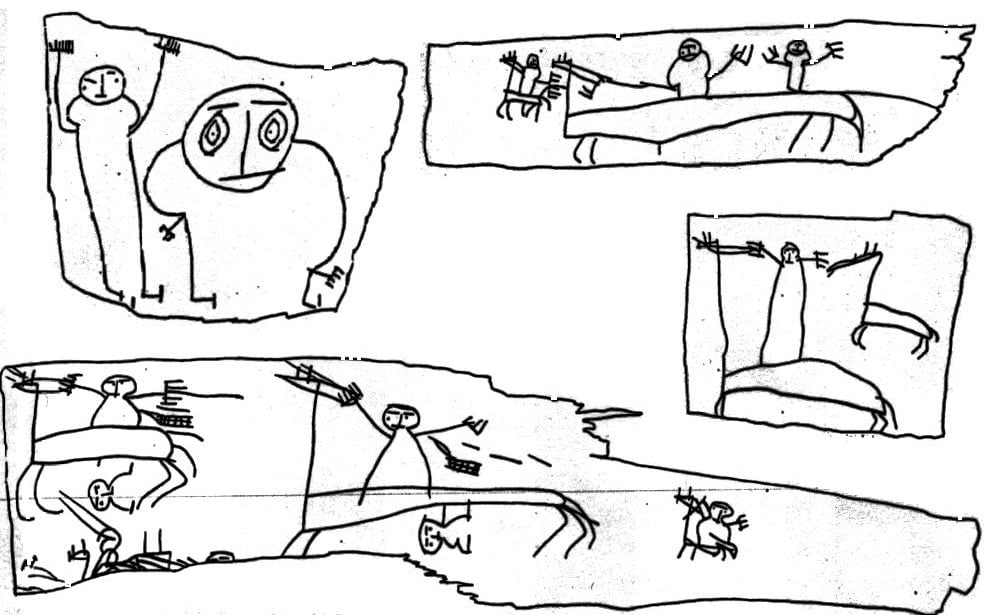
(Onfim; original uploader was Mitrius at Russian Wikipedia/Wikimedia Commons/Public Domain)
In another drawing, he made himself the hero and wrote his own name in Cyrillic letters, transliterated as Onfime:
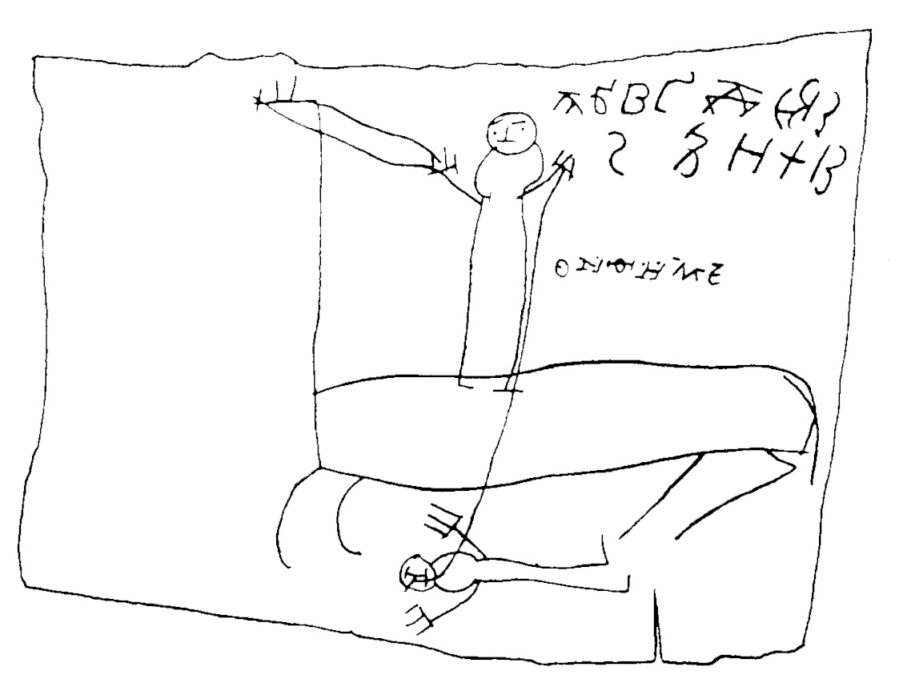
Onfim’s self-portrait portrays him as a horseman slaying an enemy. (Onfim of Novgorod, copy by gramoty.ru/Wikimedia Commons/CC BY-SA 3.0)
Literacy and birch bark in Novgorod
For a young citizen of the Novgorod Republic, Onfim’s ability to read and write was not as unusual as his age might suggest.
Researchers believe that medieval Novgorod had exceptionally high literacy levels, perhaps because extensive birch forests encircled its capital.
With its paper-like layers that could be peeled away, birch bark was abundant as a writing material and far less costly than the paper or parchment relied upon by other societies.
And the people of Novgorod certainly wrote.
Since the 1950s, more than 1,100 inscribed pieces of birch bark – also known as beresta – have been uncovered in the region, remarkably well preserved through the centuries.
These birch-bark letters date from the 11th to the 16th centuries.
Yet among this cache of beresta, Onfim’s creations are our favourites.
Why children doodle
Although doodling has been widespread for centuries, relatively little research has examined why people of every age – and schoolchildren in particular – seem to have this apparently innate habit.
One study indicates that the distraction of drawing a scene may help children manage unpleasant moods.
A study from 2009 found that participants remembered information heard during a phone call more effectively when they were able to doodle as they listened.
However, when researchers replicated this work using two slightly different experiments, their findings indicated that doodling did little to improve concentration or information absorption.
For young children, drawing offers a way to develop fine motor skills, which are an important element of how people engage with the world.
Some neuroscientists have even suggested that it plays an important role in integrating our senses, bodies and brains.
“Each stroke functions as a learning trial in which the child formulates a sensorimotor prediction ('if I move my hand like this, the mark will go there'), receives immediate feedback on the position and shape of the trace, and updates its internal models of how arm and hand movements translate into a visual and tactile pattern,” they propose.
Related: Thousands of Human Languages May Have Been Erased – Even Before Colonialism
Scribbles, doodles and drawings are often the first marks we make, preceding our move towards more abstract forms of expression, such as written words and numbers.
However Onfim’s drawings are interpreted, there is something special in knowing that children have been doodling on their homework for centuries.
This article was fact-checked and edited by Rebecca Dyer. Although we take pride in our process, we are only human. If you spot an error, please let us know.


.gif)
Comments
No comments yet. Be the first to comment!
Leave a Comment